

What Should You Consider When Choosing Disability Housing?
Choosing disability housing involves more than finding an available property. Participants and their families should consider whether the environment is safe, accessible, comfortable and suitable for the person’s everyday life.
- Accessibility and mobility requirements
- Privacy and personal space
- Location and access to community facilities
- Availability of appropriate support
- Household compatibility and living arrangements
- Personal preferences and lifestyle
- Current and future support needs
- Safety and emergency requirements
Location can also make a significant difference. For participants around Parramatta, Liverpool, Blacktown, Cumberland and surrounding Western Sydney communities, being close to family, healthcare, transport, education, employment and community activities may help support a more connected lifestyle.
Long Term Accommodation vs Supported Independent Living
Long term accommodation and Supported Independent Living (SIL) are related to housing and support but are not necessarily the same thing. Accommodation describes where and how a person lives, while SIL is a type of support designed to help eligible participants develop or maintain the skills and independence needed to live in their home.
For participants who require regular assistance with daily living, Supported Independent Living may form part of their broader support arrangement. The appropriate option depends on the participant’s individual circumstances, goals and NDIS funding.
What Support Can Be Provided Alongside Long Term Accommodation?
A participant may require different types of assistance depending on their disability and daily living needs. Support may include assistance with personal activities, household routines, meal preparation, medication-related routines where appropriate, community access and other everyday tasks.
Some participants may also benefit from structured activities that encourage social connection and participation in the community. The focus should be on providing support that is appropriate to the participant rather than using a one-size-fits-all approach.
How Does NDIS Funding Relate to Accommodation?
NDIS funding is generally based on a participant’s individual needs and circumstances. Not every accommodation cost is automatically funded through an NDIS plan, and participants may have different funding arrangements depending on the type of housing and support they require.
It is therefore important to understand the difference between housing costs and disability-related supports. A participant’s plan, goals, eligibility and approved supports should be considered before making long-term accommodation decisions.
Planning for Long Term Accommodation
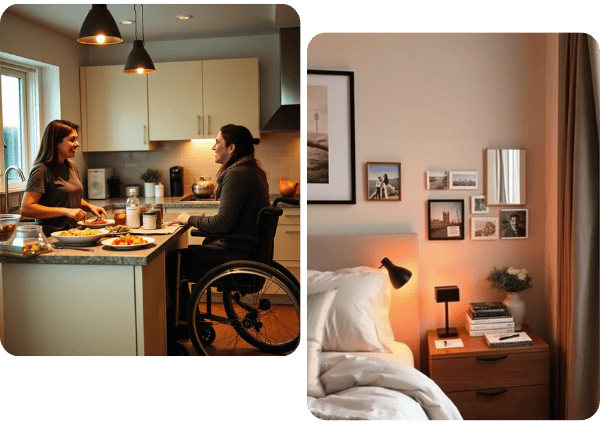
Planning early can help participants and families understand what type of living arrangement may be suitable in the future. It can also provide time to consider location, accessibility, support requirements, household arrangements and personal preferences.
A useful starting point is to identify what the participant can currently do independently, where they need assistance and what level of independence they would like to achieve. These considerations can then help inform discussions about suitable disability housing and related supports.
Long Term Accommodation in Parramatta and Western Sydney
Participants living in Parramatta and nearby Western Sydney suburbs may have different accommodation and support requirements depending on their individual circumstances. Local access to transport, healthcare, shopping, community facilities and family networks can be important when considering a long-term living arrangement.
Accucare Health Solutions supports NDIS participants with a range of services designed around individual needs and goals. From accommodation-related support to everyday assistance and community participation, the focus is on helping participants maintain choice, dignity and greater independence.